Essential Math
===
## [Trigonometry](https://en.wikipedia.org/wiki/Trigonometry)
### Right Triangle

$\sin \theta = \displaystyle\frac{\textsf{opposite}}{\textsf{hypotenuse}}$
$\csc \theta = \displaystyle\frac{\textsf{hypotenuse}}{\textsf{opposite}}$
$\cos \theta = \displaystyle\frac{\textsf{adjacent}}{\textsf{hypotenuse}}$
$\sec \theta = \displaystyle\frac{\textsf{hypotenuse}}{\textsf{adjacent}}$
$\tan \theta = \displaystyle\frac{\textsf{opposite}}{\textsf{adjacent}}$
$\cot \theta = \displaystyle\frac{\textsf{adjacent}}{\textsf{opposite}}$
### Each Trigonometric Function in Terms of the other Five

### [Unit Circle](https://en.wikipedia.org/wiki/Unit_circle)
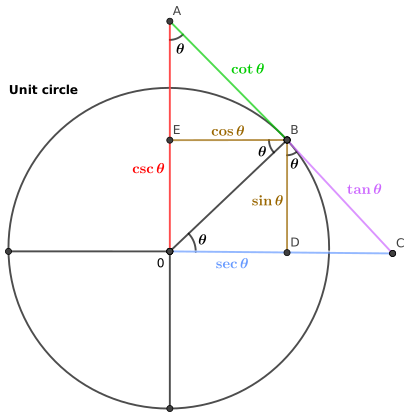

### [Trigometric Identities](https://en.wikipedia.org/wiki/List_of_trigonometric_identities)
#### Pythagorean Identities
$\sin^2 \theta + \cos^2 \theta = 1$
$1 + \cot^2 \theta = \csc^2 \theta$
$\tan^2 \theta + 1 = \sec^2 \theta$
#### Half-Angle Identities
$\sin^2 \theta = \displaystyle\frac{1 - \cos 2\theta}{2}$
$\cos^2 \theta = \displaystyle\frac{1 + \cos 2\theta}{2}$
$\sin \theta \cos \theta = \displaystyle\frac{\sin 2\theta}{2}$
## [Logarithms](https://www.rapidtables.com/math/algebra/Logarithm.html#log-rules)
### [Logarithm Definition](https://www.rapidtables.com/math/algebra/Logarithm.html#log-definition)
The logarithm is the inverse of the exponential function.
$$
\textsf{If} \hspace{3mm} b^y = x \hspace{3mm} \textsf{then}\hspace{3mm} \log_b(x) = y
$$
[Euler's Number](https://en.wikipedia.org/wiki/E_(mathematical_constant)), $e$, is often used as the base.
$$
\ln{x} = \log_e{x} \hspace{3mm} \textsf{where} \hspace{3mm} e=2.71828...
$$
When no base is specified, ten is typically assumed. This is not true in [Julia code](https://julialang.org/), where the [log function](https://docs.julialang.org/en/v1/manual/mathematical-operations/#Powers,-logs-and-roots) implies base $e$.
$$
\log{x} = \log_{10}{x}
$$
### [Logarithm product rule](https://www.rapidtables.com/math/algebra/Logarithm.html#product-rule)
$\log_{b}(xy) = \log_{b}(x) + \log_{b}(y)$
### [Logarithm quotient rule](https://www.rapidtables.com/math/algebra/Logarithm.html#quotient-rule)
$\log_{b}\left(\frac{x}{y}\right) = \log_{b}(x) - \log_{b}(y)$
### [Logarithm power rule](https://www.rapidtables.com/math/algebra/Logarithm.html#power-rule)
$\log_{b}(x^y) = y\log_{b}(x)$
### [Logarithm base switch rule](https://www.rapidtables.com/math/algebra/Logarithm.html#base-switch)
$\log_{b}(c) = \displaystyle\frac{1}{\log_{c}(b)}$
### [Logarithm base change rule](https://www.rapidtables.com/math/algebra/logarithm/Logarithm_Base_Change.html)
$\log_{b}(x) = \displaystyle\frac{\log_{c}(x)}{\log_{c}(b)}$
### [Logarithm of One](https://www.rapidtables.com/math/algebra/Logarithm.html#log-1)
$\log_{b}(1) = 0$
### [Logarithm of Zero](https://www.rapidtables.com/math/algebra/Logarithm.html#log-0)
$\large\lim_{x\to 0^{+}} \hspace{2mm} \normalsize \log_{b}(x) = - \infty$
### [Logarithm of Negative Values](https://www.rapidtables.com/math/algebra/Logarithm.html#log-negative)
$\log_{b}(x) \textsf{ is undefined when }x \leq 0$